Finney County Courthouse and Jail, Kansas
In Cold BloodThe Finney County Courthouse and Jail, Kansas, is both the site of the county’s legal proceedings and the place where Perry Smith and Dick were held before trial. Its four-story limestone structure brings courtroom, jail, and public square into close physical relation: the accused pass through a watching crowd to reach cells above, while the trial later convenes in a courtroom on the third floor. The building’s arrangement makes justice visible as a public event and confinement an intimate, everyday presence.
Building and Internal Arrangement
The courthouse is described as a four-story limestone structure, with the county jail occupying its top floor and the courtroom on the third. A separate apartment on the fourth floor, called the Sheriff’s Residence, is divided from the jail proper by steel doors and a short corridor. Its pleasant, lived-in rooms stand in marked contrast to the institutional austerity of the jail.
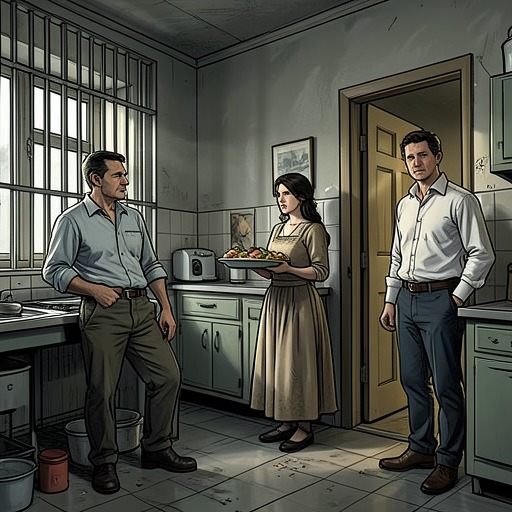
In January 1960, the apartment was occupied not by Sheriff Earl Robinson but by undersheriff Wendle Meier and his wife, Josephine Meier. Their five-room home—with lace curtains, cushioned chairs, and other domestic furnishings—was also adjacent to the women’s cell. The jail had six cells; the sixth, designated for female prisoners, was an isolated unit opening from the residence beside the kitchen. Josephine Meier treated the arrangement as ordinary company while she cooked and worked, making the boundary between prison and home unusually close.
The Return and Confinement of the Accused
On Wednesday, January 6, a crowd gathered in the square in anticipation of Perry Smith and Dick’s return. News reporters and camera crews had assembled in Garden City, and space was reserved on the courthouse sidewalk for them to watch the prisoners climb the steps toward the jail. The crowd included local residents, students, families, and a Boy Scout troop. Though an out-of-town headline had suggested that a lynch mob might be waiting, the gathering did not attack the prisoners: by the time the cars arrived after dark in bitter cold, many spectators had gone home, and those who remained watched silently.
From her kitchen window overlooking the square, Josephine Meier followed the arrival while preparing food. She recalled seeing Dick first, dressed lightly for the cold and looking ill; Perry Smith followed. She had made supper beyond the jail’s regular meal schedule, but Perry Smith declined it and looked out the window. The public journey up the courthouse steps ended not in a courtroom but in separate cells: the sheriff wanted the two men kept apart until after trial, and Perry Smith was placed in the unusual cell beside the Meiers’ kitchen.
Courtroom and Trial
The third-floor courtroom was a plain chamber with white walls, dark varnished furnishings, and benches for about 160 spectators. On March 22, the first morning of court, the benches held the all-male pool of potential jurors from Finney County. Jury selection, expected to take days, was completed in four hours. The fourteen men selected included two alternates; candidates were dismissed for reasons that included opposition to capital punishment or a fixed opinion about the defendants’ guilt. Four selected jurors acknowledged knowing Herbert William Clutter, though each said the acquaintance would not prevent impartial judgment.
The courthouse also framed the trial’s closing arguments. Judge Tate instructed the jury before the state’s summation, delivered with the help of Logan Green, an experienced special assistant brought in to support county attorney Duane West. The defense followed with appeals against capital punishment and for mercy. In this room, the case’s competing claims about guilt and punishment were presented to a local jury, within the same building where the defendants had been held apart.
Domestic Care and Institutional Meaning
Josephine Meier’s account makes the jail more than a setting for custody. She cooked, sewed, and did laundry for prisoners, and prepared an extra supper for Perry Smith and Dick when they arrived. Her kitchen window also gave her a view of the square where the crowd waited. From inside the residence, the spectacle outside and the care of prisoners within were parts of the same evening.
The courthouse and jail therefore join public judgment to private routine without erasing the difference between them. The square supplies the audience; the courthouse steps stage the prisoners’ arrival; the cells impose separation; and the kitchen offers food that Perry Smith refuses. The building’s layered uses make punishment at once civic and domestic: a legal proceeding observed by the town, carried out in a structure where confinement borders a family home.